Consent & Boundaries · 3 min read
The Wheel of Consent: Boundaries, Choice and Self-Trust
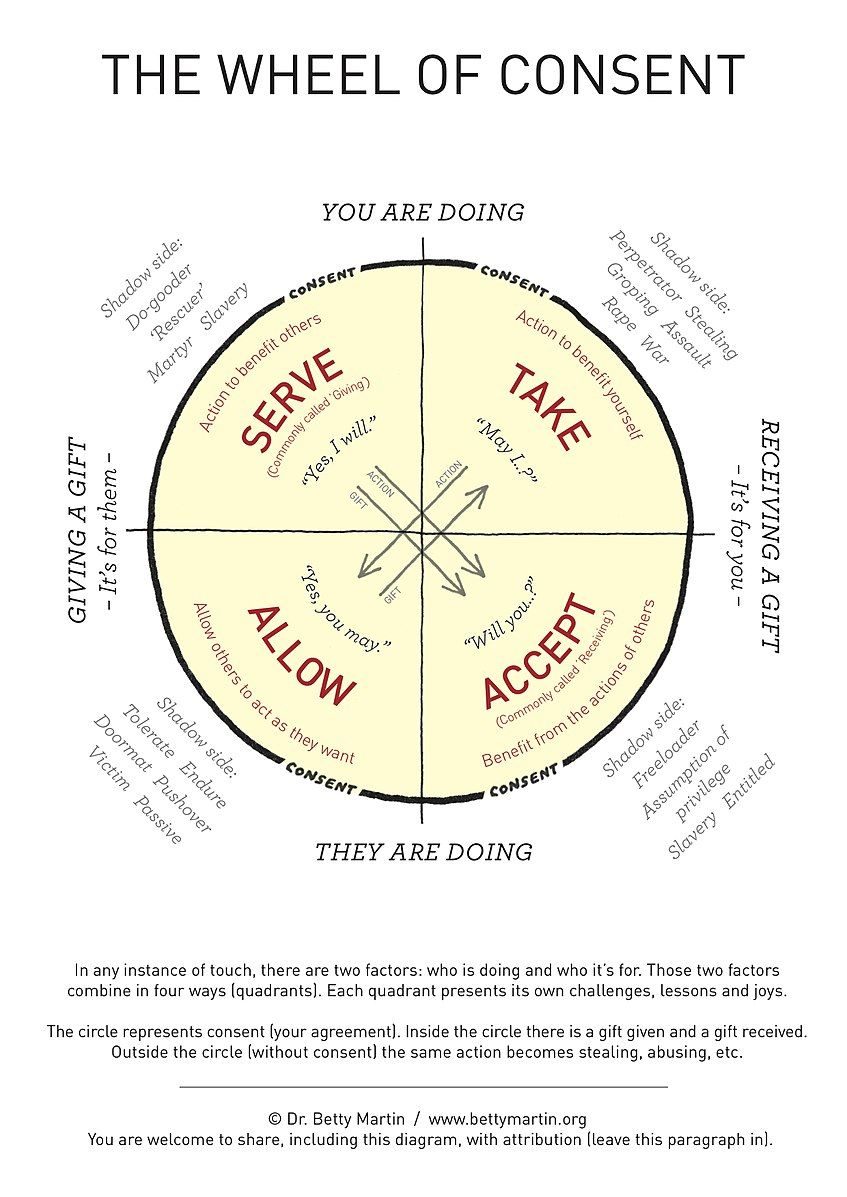
Relationships can feel confusing, and that confusion is often what first brings people to therapy. You might say yes when you mean no, feel responsible for other people’s feelings, freeze when put on the spot, or only realise afterwards that something did not feel right.
Betty Martin’s Wheel of Consent offers a simple but powerful way to explore these patterns. Although it originally emerged from work with touch, it can be applied much more widely to relationships, boundaries, giving, receiving, asking, allowing and choosing.
At the heart of the Wheel are two questions:
- Who is doing?
- And who is it for?
These questions can reveal a lot. Sometimes we are doing something for someone else. Sometimes we are allowing something because it is genuinely for the other person and we are willing. Sometimes we are receiving something we have asked for. Sometimes we are acting for our own enjoyment, with another person’s clear consent.
The difficulty is that these dynamics often get blurred.
We might offer care while secretly hoping someone notices how tired we are. We might agree to something because we do not want to disappoint. We might let someone lean on us, advise us or touch us while overriding the quiet signals in our body that say no.
The Wheel of Consent helps us slow these moments down.
Consent is more than the absence of a no. A yes can come from fear. A no can feel impossible. A maybe may be the body asking for more time. For people with trauma histories, people-pleasing, shame or relational wounds, consent can be complicated.
In therapy, working with consent is not only about sexual or physical boundaries. It is also about noticing the subtle ways we abandon ourselves. Where do I override myself? Where do I agree too quickly? Where do I give from obligation rather than genuine willingness? Where do I struggle to receive without guilt?
The Wheel describes four dynamics: serving, accepting, taking and allowing. None are inherently good or bad. All can be healthy when there is clarity, agreement and choice. All can become painful when consent is assumed, pressured or unclear.
Giving can be beautiful, but if we are always serving others without checking what we want, we may become resentful or exhausted. Receiving can be nourishing, but if we feel guilty when someone cares for us, support may be hard to let in. Allowing can be generous, but if we allow something because we fear someone’s reaction, it is not true consent.
Many clients have learned to survive by being highly attuned to others. They may know what someone else wants before they know what they want themselves. This can be especially true for people who grew up around emotional unpredictability, criticism, abuse, neglect or parentification.
Therapy can help you notice the difference between a genuine yes and a protective yes. Between generosity and self-abandonment. Between care and over-functioning. Between receiving and feeling indebted. Between desire and obligation.
The body often knows before the mind has words. A true yes may come with breath, ease or aliveness. A no may show up as tightening, pulling back, numbness, irritation or collapse. Therapy can help rebuild trust in these signals gently and at your own pace.
For clients who choose body-based or touch-based work, consent must always be ongoing, explicit and reversible. A yes at the beginning does not mean yes forever. You can pause, change your mind, ask for something different, or stop at any time.
The Wheel of Consent is not about getting boundaries perfectly right. It is about developing more awareness and choice.
It can help you pause before automatically saying yes. It can help you notice when you are acting from fear, habit or obligation. It can support you to give more freely, receive more fully, and say no with less shame.
Consent is not only about boundaries.
It is also about dignity, agency, safety, pleasure and the right to belong to yourself.
Samantha Whittaker · Compassion Space
← All posts